Creation in Chaos
Intelligence: Are We Developing It—or Destroying It?
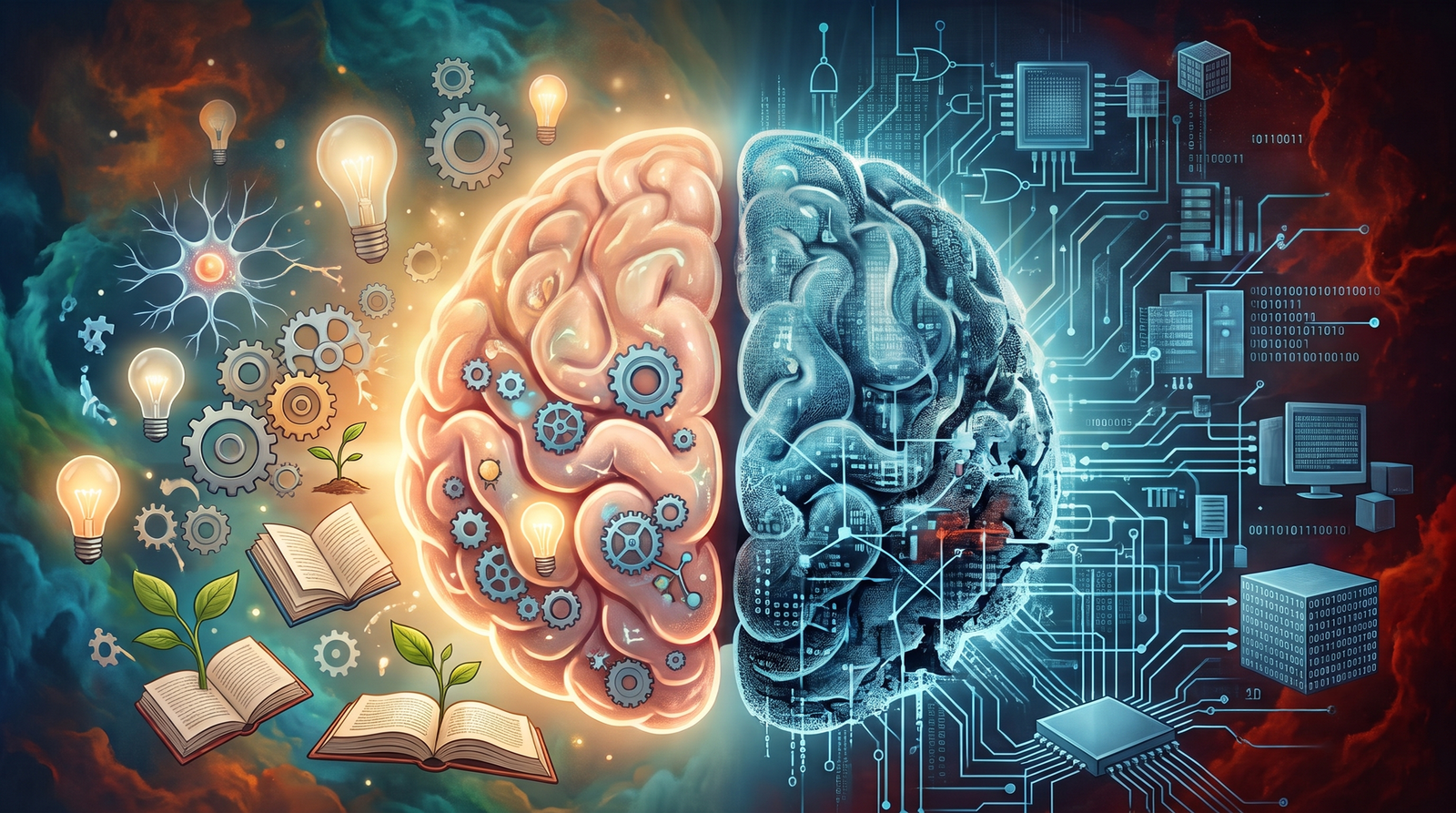
Anything we stop using or caring for over a long period of time begins to lose its strength.
Metals rust when they are left unused and unprotected. Muscles weaken when we stop exercising and fail to provide them with proper nutrition.
So, could the same principle apply to intelligence?
Before answering that, let us first understand what intelligence really means.
Intelligence is the ability to learn, understand, reason, solve problems, and adapt to new situations.
As we evolve, we are beginning to recognize different forms of intelligence: General Intelligence, Creative Intelligence, Emotional Intelligence, Executive Intelligence, and Artificial Intelligence.
But intelligence does not truly evolve through repetition alone. It develops through experience, reasoning, analysis, uncertainty, failure, reflection, and adaptation.
Often, this process involves pain.
We question ourselves: Was this really the right way? Could I have done something differently?
Yet that very struggle can bring the satisfaction of achievement. It can open an alternative perspective. And when we pause, look back, and compare our decisions with their outcomes, we gain something much more valuable than an answer—we gain wisdom.
The AI Era
Today, we are investing enormous amounts of time and energy into developing Artificial Intelligence, Machine Intelligence, and perhaps one day, Superintelligence.
But have we stopped to ask a fundamental question?
Is all the information we are feeding into these systems actually correct?
Human understanding has changed repeatedly throughout history.
There was a time when people believed the Earth was flat. There was a time when we believed the Earth was at the center of the universe. New discoveries repeatedly challenged what was once considered absolute truth.
Every major discovery has shown us that knowledge is not always the same as truth.
Yet, in the race toward artificial intelligence, are we becoming increasingly dependent on existing information while overlooking the original sources from which intelligence has always emerged—nature and life itself?
The Intelligence We Are Overlooking
We sometimes behave as though we already know everything.
We consider ourselves creators and owners of nature, while continuously consuming its resources without always thinking about restoration.
We consider ourselves creators of children simply because we give birth to them, while forgetting that children themselves are extraordinary sources of curiosity, creativity, imagination, experimentation, and learning.
And now we are creating AI and robotics capable of producing results at extraordinary speed.
But the question is:
Are we truly ready for the world we are creating?
Speed Without Essence
In this race toward faster generation and faster consumption, something important may be getting lost.
Essence.
Everything becomes optimized, predictable, mechanical, and increasingly unreal.
Consider robots that can dance, cook, or perform tasks that humans once considered uniquely human.
A robot can be programmed with a particular set of variables and instructions for dancing. It may perform the movement perfectly.
Now imagine two robots performing the same dance.
At first, it may feel fascinating.
But after watching them repeatedly, something begins to feel missing.
Why?
Because their possibilities are largely defined by the instructions given to them.
Now compare that with two human beings.
Teach the same dance step to two different people.
The movement may be technically the same, but the expression will not be.
One person may bring energy. Another may bring softness. One may be precise. Another may introduce a small variation. Their bodies, emotions, experiences, confidence, culture, and personalities influence how they interpret the same instruction.
The same thing happens with food.
Give two people the same ingredients and the same recipe. They may prepare the same dish, yet the taste can still be different.
Why?
Because cooking is not merely following instructions. It involves timing, pressure, intuition, experience, attention, emotion, and countless subtle decisions that may never have been explicitly programmed.
This is where human intelligence reveals something that information alone cannot capture.
What Happens When We Remove Uncertainty?
So, while developing Artificial Intelligence and Superintelligence, are we also developing the natural intelligence that exists within life?
Or are we slowly weakening it?
If we continuously present AI-generated information as though it is absolutely correct, are we leaving enough room for humans to question it?
Are we teaching ourselves—and future generations—that there may be another possibility?
Are we giving people enough opportunities to experience life without AI solving the problem first?
Because intelligence does not grow only when we receive the correct answer.
It grows when we experience:
“No.”
“I don’t know.”
“You are wrong.”
“I failed.”
“Try again.”
“Look at it differently.”
Rejection, failure, uncertainty, and disagreement can be uncomfortable. But they can also become powerful teachers.
Wisdom is not simply knowing the answer.
Wisdom is developing the ability to recognize that your answer may not be the only possible answer.
Are We Trading Intelligence for Convenience?
In the name of freedom of expression, are we sometimes creating environments where everyone feels entitled to believe that their perspective is the only correct one?
And in the name of AI and efficiency, are we allowing technology to take over experiences that were once essential for developing our own intelligence?
If AI increasingly thinks, creates, writes, cooks, dances, decides, and solves problems for us, what happens to our own Creative Intelligence, Emotional Intelligence, Executive Intelligence, and ability to reason independently?
Perhaps the greatest risk is not that AI becomes intelligent.
Perhaps the greater risk is that humans stop exercising their own intelligence.
Just as unused muscles weaken, could an intelligence that is rarely challenged, questioned, or exercised begin to weaken too?
Creation or Destruction?
We are building a faster world.
But are we also building a better world?
As we generate information faster, are we generating wisdom at the same speed?
As we create artificial intelligence, are we nurturing natural intelligence?
As we remove uncertainty, are we also removing curiosity?
As we make everything more predictable, are we losing the beauty of the unknown?
And as we create an increasingly connected external world, what is happening to our internal world—our emotions, curiosity, creativity, relationships, sense of wonder, and feeling of being alive?
Perhaps the real question is not:
“How intelligent can AI become?”
Perhaps we should first ask:
“How intelligent do we want humanity to remain?”
Because if our pursuit of artificial intelligence makes our natural intelligence weaker, then what exactly are we creating?
A brighter, warmer future?
Or a perfectly efficient world filled with numbness, uncertainty, distrust, disconnection, and disbelief?
Maybe the greatest challenge of our time is not learning how to create intelligence.
Maybe it is learning how to create technology without destroying the conditions that allow intelligence, creativity, wisdom, and life itself to flourish.